 Granada Hills Appliance Repair
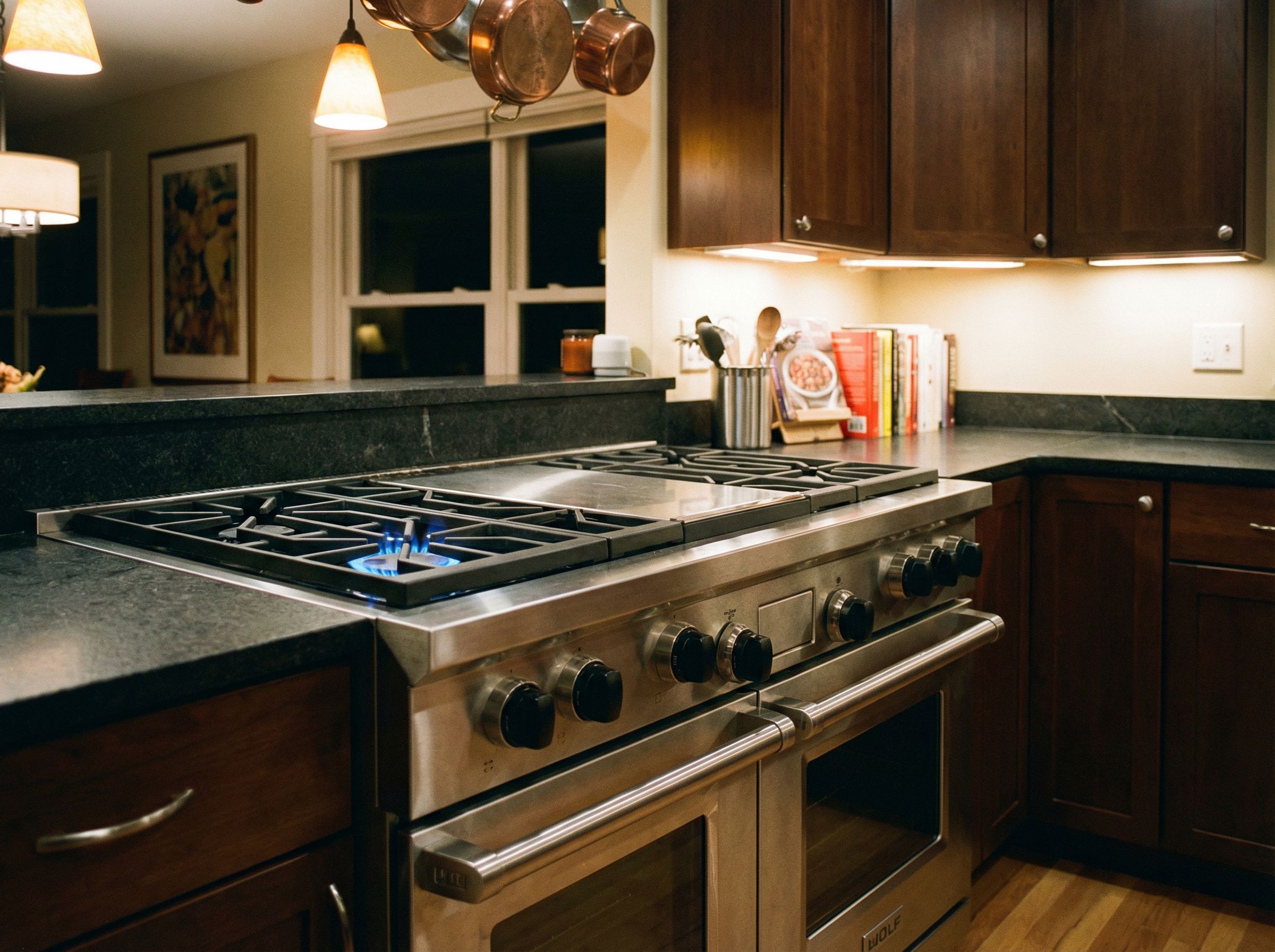
If you live on Jimeno Avenue, Lisette Street, or Nanette Street, you already know what you have. The Balboa Highlands tract is one of only a handful of Joseph Eichler developments in Southern California — about a hundred post-and-beam homes built in the early 1960s, and since 2010 a designated historic district. People buy these houses on purpose. They fly in from out of state to buy them. And then a wall oven dies, and suddenly they’re standing in a 60-year-old galley kitchen learning a hard truth: the appliance industry stopped making things in these dimensions decades ago.
I’ve been repairing appliances in the north Valley since 1989, and Balboa Highlands calls are some of my favorite jobs and some of my most careful ones. Here’s what owners of these homes need to know.
The 24-Inch Problem
Eichler kitchens were designed as a unit. The galley layout, the flat-panel cabinetry, the slim built-in wall oven and the drop-in cooktop — it’s all one composition. The original wall ovens in these homes are typically 24 inches wide. Sometimes 27. The cooktops are shallow-depth units set into a countertop run that has no spare inch anywhere.
Walk into an appliance showroom today and try to find a 24-inch wall oven. There are a few — mostly European brands, mostly compact convection units — and almost none of them match the cutout depth, the trim style, or the venting of the original. The standard American wall oven is now 30 inches. So when a big-box installer looks at your dead 1962 oven, his answer is simple: cut the cabinet.
And that’s the whole ballgame. Once someone takes a saw to original Eichler casework — those clean mahogany or lauan panels, that continuous line down the galley — you cannot un-cut it. The cabinetry is not replaceable at any reasonable price. In a designated historic district, interior work generally isn’t regulated the way the exterior is, but the market absolutely regulates it. Realtors who sell in this tract will tell you flat out: an intact original kitchen adds real money to a Balboa Highlands sale, and a hacked-up one subtracts it.
So my default position on these homes is different than it is anywhere else in Granada Hills: repair first, repair second, and replace only when the math truly forces it.
Yes, the Old Stuff Is Repairable
The vintage units we see in these kitchens — Thermador wall ovens, O’Keefe & Merritt ranges, occasionally an old Tappan — were built in an era when appliances were electromechanical. No control boards. No proprietary software. A 1962 Thermador wall oven is a thermostat, an element or a burner assembly, a selector switch, a door hinge, and wiring. Every one of those things can be diagnosed with a meter and replaced or rebuilt.
Parts are the challenge, not the labor. Here’s the honest picture:
- Heating elements for vintage Thermador ovens can often be cross-referenced to universal elements or sourced from specialty suppliers. Sometimes an element can be rebuilt with new terminals. Typical repair with sourcing: $250-450.
- Thermostats are the most common failure on 60-year-old ovens. Originals are scarce, but rebuilt units and compatible modern hydraulic thermostats exist for most models. Expect $300-500 installed, and expect us to need a week or two to source it.
- O’Keefe & Merritt parts are actually in decent supply because there’s a whole restoration community around these stoves. Valves, robertshaw thermostats, griddle parts, even chrome — it’s out there. A full restoration runs into the thousands, but a repair to get one burner or the oven working again is usually a few hundred dollars.
- Door hinges and seals are almost always solvable. Don’t live with an oven door that won’t close because someone told you the part doesn’t exist. It exists, or it can be fabricated.
What we can’t always fix: badly cracked porcelain interiors, ovens where a previous owner’s “repair” melted the wiring harness, and units where the cavity itself has rusted through. That’s maybe one call in ten.
The Radiant Heat Wrinkle
Balboa Highlands homes came with radiant heating in the slab or ceiling panels — no forced-air ducting anywhere in the original design. That has a downstream effect people don’t expect: kitchen ventilation in these houses is quirky. There’s no duct chase to borrow, the flat roof has minimal cavity to run new duct through, and many of the original cooktops vented through slim hoods or downdrafts that were marginal even when new.
Why does a repair guy care about your ventilation? Two reasons. First, poor ventilation shortens appliance life — grease and heat cook the cooktop’s own switches and wiring from above. When I see a vintage cooktop with heat-brittled wire insulation, the hood above it usually hasn’t moved real air since the Johnson administration. Cleaning or repairing the existing hood fan is cheap insurance for the appliance below it. Second, when people replace a cooktop with a modern high-BTU unit, the old ventilation can’t handle it, and now the new appliance suffers the same fate — plus the kitchen ceiling gets a grease film on those beautiful exposed beams. If you upgrade burner output, the hood conversation has to happen at the same time.
Also worth knowing: some of these homes still run on their original electrical panels with limited spare capacity. A modern 30-inch electric wall oven can draw considerably more than the 1962 unit it would replace. “Just swap it” sometimes secretly means “just swap it, plus a circuit, plus panel work.” Another point for repairing what’s there.
What to Ask Before Anyone Drills Anything
If you own a home in this tract, put any technician — me included — through these questions before work starts:
- “Can this be repaired without modifying the cabinet, countertop, or wall?” Make them answer yes or no before they quote a replacement.
- “Have you worked on electromechanical ovens from this era?” A tech who has only ever swapped control boards will misdiagnose a 1962 thermostat every time.
- “If a part has to be sourced, what’s the plan and the timeline?” Vintage sourcing takes one to three weeks. Anyone promising same-day parts for an O’Keefe & Merritt is guessing.
- “If you drill or cut, exactly where, and why?” Sometimes a fastener genuinely has to go into something. Fine. But it should go into a location that’s already penetrated or fully concealed, and you should approve it first.
- “What happens to the original unit if we do replace?” Never let a working-condition vintage Thermador or O’Keefe & Merritt go to the dump. Restorers pay for these. So do other Eichler owners two streets over.
The Bottom Line for the Highlands
A dead appliance in a normal Granada Hills kitchen is a math problem. In a Balboa Highlands kitchen it’s a preservation problem with a math component. Our rule on these calls: we diagnose first ($85 service call, waived if you proceed with the repair), we tell you honestly whether the original unit can live again, and we never cut original material to force a modern unit in. If replacement genuinely is the right answer, we’ll help you find a compact unit that fits the existing cutout — they exist, and the search is worth it.
Your kitchen survived sixty years. It shouldn’t die on a Tuesday because someone had a reciprocating saw in the truck.
Own an Eichler with a struggling oven or cooktop? Call us at (818) 330-5907 and mention you’re in Balboa Highlands — we’ll send the right tech, not the fastest one.
Granada Hills Appliance Repair has served the San Fernando Valley since 1989. We service all makes and models — including the ones nobody makes anymore — with a 30-day labor warranty and 90-day parts warranty on every repair.